Friday, June 17, 2011

Mossbrae Falls Expedition

Mossbrae Falls is described by Wikipedia as one of the most scenic waterfalls in California. It is 50 feet high, 150 feet wide, and tumbles over a wall of verdant green moss and ferns ("brae" is a Scottish word for "hillside"). The falls are created by springs high up the mountain, which run down the canyon wall and into the Sacramento River, creating the effect of many waterfall streams falling into the river. This collage shows some views of the falls, with my son and I in the foreground. I was thankful for the automatic setting on my camera to get the photo of both of us, since there was not another person there to snap the photo for us! It is a very quiet retreat from the hustle and bustle of everyday life!


Part if the fun of getting to Mossbrae Falls is the hike to get there. A visitor walks along an active railroad track, that follows the Sacramento River, for about a mile. We only met two other hikers whenever we were there, and we were fortunate that no trains went by during the time we were walking along the tracks. The upper sections of the Sacramento River where the falls are located, often attract fisherman, as evidenced by the photo in the top part of this collage. The sound of the rushing water of the river, coupled with the falling of the spring waters into the the pool in front of the waterfall, bring to mind the words of Jesus that say "Whoever believes in me, as the Scripture has said, streams of living water will flow from within him."
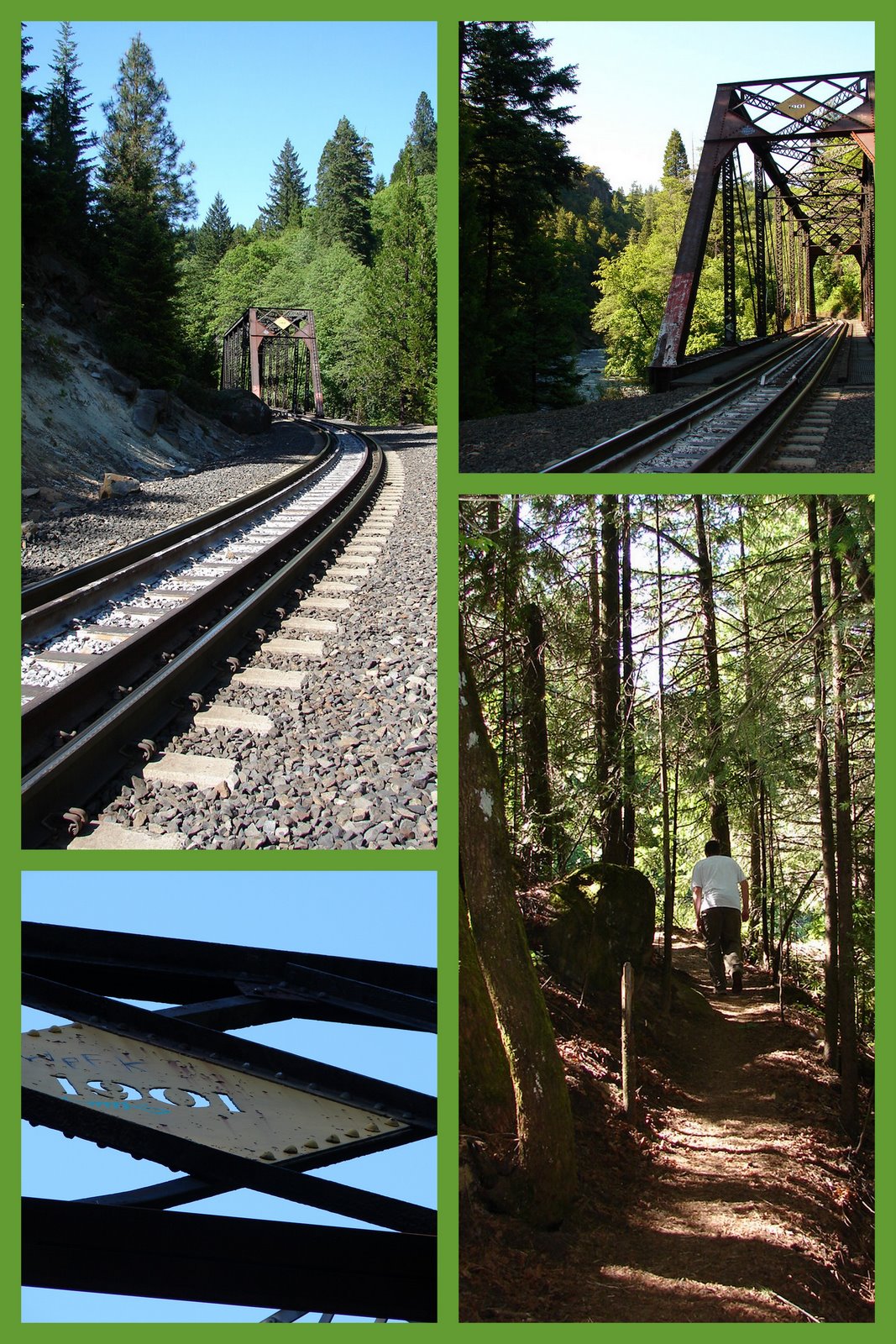


You will know you have arrived at the falls when you get to the railroad trestle over the river, with the date "1901" on it. Although you cannot see the falls from the tracks, you will hear them. Look for a trail off to the right through some trees (see lower right photo of this collage), and follow it through the woods a very short distance to the falls.


After we finished the hike, we came back to the charming town of Dunsmuir, California, to have supper at an outdoor cafe that had delicious food, as well as live music outside, on the night we were there (lower right photo). Dunsmuir is known as a "railroad town", and in fact, still has an active Amtrak station there. I have ridden on the Amtrak train that goes through this section of northern California, but it was dark and snowy when we went through, so I could not really get a sense of the beauty the area has. You can find out more about visiting the Dunsmuir area by visiting their website, www.Dunsmuir.com. However, due to safely concerns about hikers along an active railroad track, they no longer give directions to the hidden gem, known as "Mossbrae Falls"on their website. Yet, there are plenty of sites on the Internet that give directions, plus I read about it in a publication called 101 Shasta Things To Do, also available on line at www.101ThingsShasta.com. Next time you are in the mood for a little exercise, with seeing a beautiful waterfall, as the reward for that exercise, make a visit to Mossbrae Falls. Miles of smiles!! Tricia

Posted by Picasa

Wednesday, June 1, 2011

RED ROCKS AMPHITHEATER

I have been on a quest the last few years to visit outdoor amphitheaters, and of all those I have visited, the Red Rocks Amphitheater is the most spectacular, in terms of its natural setting. It is located a few miles west of Denver, Colorado; in fact, the Denver skyline is visible in the distance when one is sitting in the upper levels of the amphitheater. This is by no means, a new amphitheater, although its components have been updated to make it "state of the art", in terms of concert and performance venues. Its use as an amphitheater for performances dates back to around 1910, when John Brisben Walker produced concerts there on a temporary platform. Those early beginnings planted the "seeds" for the Red Rocks Amphitheater becoming a world famous entertainment venue. Famous artists have helped cultivate those seeds during the past several decades. This was most famously done because of a video put out by the band U2, from a concert event that they performed there in 1983. People around the world viewed the video, and were in awe, not only of the band, but also the scenic location of the concert. It was later listed in Rolling Stone's magazine list of the "50 moments that changed Rock and Roll." None of the famous concerts held there would have been possible, if the city of Denver had not purchased the property in 1927. With the help of the CCC (Civilian Conservation Corps) and WPA (Works Projects Administration), the amphitheater structures were built. It was formally dedicated in 1941.


This stunning scene from midway down into the amphitheater shows the seating that is bordered by a huge sandstone vertical rock, angled outwards from stage right. It is called Creation Rock.


The amphitheater holds 9, 450 people. This photo shows that there are other choices for concert viewing besides the typical bleachers. This biker couple is stretched out on the graveled and shaded plaza areas that border both sides of the bleachers. Judging from the number of families with strollers I saw using these same plazas, it is also a good location for a baby to sleep!


This 300 foot sandstone monolith sits at the top of the amphitheater, where there is as expansive concrete plaza with concession stands and restrooms, as well as a sit-down, air conditioned restaurant. It is noteworthy that the restaurant is open daily, even if there is not a concert scheduled. Likewise, one can take a guided tour of the amphitheater, on most days of the year. You can find out information on this, and about all the surrounding park has to offer (such as hiking trails, picnic areas, Visitor Center, etc) by visiting their official website, www.redrocksonline.com Since Denver has the nickname of the "Mile High City", and the rocks shown on these photos are even higher than that, I was reminded of the verse in the second part of Psalm 61:2 that says "Lead me to the rock that is higher than I." Of course, the psalmist is referring to God, yet I would also recommend being led to the high rocks (and rock concerts) of this gorgeous place! It will give you miles of (vertical!) smiles! Tricia


Posted by Picasa

Saturday, May 28, 2011

Pepper Sauce Alley Ghosttown

I have been traveling through the small community of Calico Rock---located on the banks of the White River in north central Arkansas---for decades, but it wasn't until this past year that I ventured off the town's Main Street (also known as Highway 5) that I discovered an outdoor "museum" of sorts, that gives one a glimpse of days gone by.


Just east of Main Street is a six-block area called "Pepper Sauce Alley". In times past, it was considered a disreputable part of the town, where "good girls" did not go. Since all my trips to Calico Rock as a youngster, were with a church youth group, this part of the community was not on our tour itinerary! You see, the "Pepper Sauce Alley" name refers to the fact that "Pepper Sauce" was the local term for illegal spirits (the drinking kind), which the reader may have heard also called "home brew" or "white lightning". But now, it is a different kind of spirit that is revitalizing the area. In fact, the official website for tourism in Arkansas (www.Arkansas.com) says Pepper Sauce Alley causes Calico Rock to have the distinction of being the only community in the USA with an authentic "ghost town" within its city limits!


As you enter the ghost town, there is a large sign, explaining that the group responsible for the signage along the walking tour, is an organization called C.O.R.E., which stands for Calico Rock Organization for Revitalization Efforts. As you venture deeper into the area, one can read very well-done placards, telling about the history of the building it is describing, along with historical photos. It is fun to compare the actual building you are looking at in "real time", with how it looked decades ago, when the area was a thriving trade center. Each of the signs has a warning, however, that the buildings are on PRIVATE PROPERTY, and there is a strict NO TRESPASSING policy inside the buildings. The one exception is the old city jail. A tourist can go inside that tiny one-room, concrete block building, but I declined that wonderful opportunity. The fact that there are rumors saying the jail is haunted with spirits had nothing to do with my decision.


As I viewed the old weathered doors throughout Pepper Sauce Alley---some boarded shut, some locked and bolted, and some completely missing---I was reminded of a scene of a familiar painting that had hung in the home of my grandparents until they died. It was the scene of Jesus standing outside the door of an edifice, knocking, as if asking permission to come inside. It is based on the verse in the Bible where Jesus is saying "Here I am! I stand at the door and knock. If anyone hears my voice and opens the door, I will come in and eat with him, and he with me." (Revelation 3:20) The imaginations of the folks who have told us the story of Pepper Sauce Alley must also have been stirred by the doors that they saw, and thought they were worth sharing with the rest of the world, by taking a walking or driving tour, through Pepper Sauce Alley. The area is next to a lovely city park, complete with a creek, walking trail, and picnic tables. Since the entire downtown of Calico Rock is on the National Register of Historic Places (and has served as a movie set!), I would definitely recommend a visit there. Ideas for additional area activities and history information is available at www.calicorock.us. Next time you are on a familiar drive, take the time to venture off the route you usually take, and see what you discover. It will likely lead to "miles of smiles"! Tricia

Posted by Picasa

Monday, May 23, 2011

The "Quarterly" Expeditions

This is the first in a series telling about my experiences visiting the places that each state in the USA has chosen as SOoooo significant, they want it to be printed as the symbol for their state, and placed on the special "state quarters" produced by the U.S. Mint during the first decade of the second millenium. I am starting with Indiana, because that state chose to recognize its famous event---"The Indy 500"--- as represented by the photo of an Indy-style racecar, shown in the top photo of this collage. It seems particularly timely since the race is held on Memorial Day weekend (which is just days away), AND it is the 100th anniversary running of the world's most famous race.


People come from all over the world to be a part of this---the greatest spectacle in racing. This photo shows the famous "pole" that indicates which drivers go where, when the familiar command "Start Your Engines" is given, and thousands of black and white balloons rise above the monstrous track.


When I made the Indy pilgrimmage some time ago, it was by motorcycle. My husband and I made the trip between northern Arkansas and Indianapolis in a leisurely two-day drive at the beginning of our Indy 500 adventure. However, because the race was delayed by a full day due to rain, we had to scurry back home all in one day, after the race was over. I guess that was the longest non-stop trip we made---a full 12 hours of riding, at the maximum speed limit, on a Harley-Davidson Softtail. After 12 hours of riding on that so-called "Softtail" however, I had a DIFFERENT name for it! At least, we did not have to drive to the various Indy event venues, once we arrived in Indianapolis. We had bought a package that included the hotel, race tickets, parade tickets, access to the garage and pit area, and motorcoach transfer (with a police escort!) to the "brickyard" (aka, Indianapolis Motor Speedway). I would definitely recommend the "package" route, especially if you are unfamiliar with the area, and will be needing to book some type of commercial lodging. It is not exactly easy to navigate the huge 253 acre park. It is so large that Yankee Stadium, Churchill Downs, the Rose Bowl, even Vatican City could fit inside the 2.5 mile track.


This photo collage is a reminder of some of the other famous race tracks I have had the opportunity to visit. The Kansas Speedway (just west of Kansas City, in the state of Kansas) was especially memorable. It is memorable not so much because of the race itself, as what happened AFTER the race, when my sister and I tried to find our car. It seems that in our excitement to get inside the speedway when we first arrived, we jumped out of our car to catch the parking lot trolley, without giving any thought to where we had parked. It was early in the day, so the grassy fields used for parking the thousands of cars was largely empty. Imagine our surprise when the race ended, and we exited the track to see a vast OCEAN of parked cars. We had no idea where to start looking, so we just went up and down every single row. As darkness approached, we were exhausted from searching, so we finally just stopped and sat down to rest, deciding our only option was to wait until every single car on the gigantic prairie they called a "parking lot", was gone. Lots of people felt sorry for us, however, and invited us to join in their tailgate parties. FINALLY, when there were only about two dozen cars remaining on the "prairie", a click of our car key made one of the car's lights come on, and we were reunited with our long lost transportation home!!! PTL!!! We learned a real lesson from that experience, however. We now take a photo with our cell phone of where we park! The lower left photo is a reminder of the Daytona Speedway, where I got to attend motorcycle races. The lower right photo is a souvenir from my time at the Charlotte Raceway. It was a special event there where I got to actually be timed while changing the tire on a racecar AND had the opportunity to ride around the track in a stock car, used to let tourists experience the "feel" of a NASCAR track. Not surprisingly, all this writing about races, has brought to mind one of the most well-known Bible verses about races: "Do you not know that in a race all the runners run, but only one gets the prize? Run in such a way as to get the prize." I Corinthians 9:24 So for the big Indy 500 race coming up this weekend, I am rooting for the gal (Danica Patrick) to get the prize! Miles of (230 mph) smiles! Tricia

Posted by Picasa

Thursday, May 19, 2011

Hawaiian Sunsets

There are SO MANY enjoyable activities that one can do when they are visiting the Hawaiian Islands, it is impossible to "do it all" in one visit to such a place. This photo shows the ever-popular surfing and boogie boarding on Waikiki Beach on the island of Oahu. The sailboat on the horizon is an example of another activity---taking a day-sail trip on one of the catamarans that are moored on the beach, ready to take on a new boatload of tourists several times a day. Yet another activity is strolling the beach with your camera, hoping to capture an incredible scene like this one: The sun seemed to have singled out this particular sailboat to shine down on and engulf in all its glory, in an otherwise cloud-covered atmosphere. When I was actually seeing this in "real life", I kept thinking, "This is amazing!! I wonder what the photograph will look like? Will it even begin to capture the beauty and the rarity of such a sight?" (Well, at least it was a rare sight to this viewer who lives in a land-locked state like Arkansas, where there are no oceans on ANY of the state's borders.) I saw the shining "glory hole" open up in the clouds on the horizon several minutes before the sailboat actually went through it. I was silently hoping that the hole would stay open until the sailboat passed through it, and to my great delight, it did! The result is this photo!


If the catamaran sailboat is not your "cup of tea", you can still experience a day-sail on a more traditional, V-bottom sail boat such as this one. They generally cost more that the boats that hold more people, but will probably give you more of a "crew sailing" experience. The first time I ever did one of these trips was with my husband and my son, down in Ft. Lauderdale, Florida. Part of the allure of that boat was that it had originally belonged to famous TV anchor-man, Walter Cronkite. It seems that being a "TV anchor" was second only to "lifting anchor" on his sailboat, in terms of his favorite activities! In this photo, I happened to be strolling the beach whenever the boat was returning to its mooring spot on the protected harbor near the end of the Waikiki Beach, just after sunset.


You can take one of the charter sailboat trips at any time of the day. The location of the sun in this photograph shows that this trip was in the late afternoon. Such excursions often include an opportunity for the guests on board to take a swim in the ocean for a short time, or perhaps even do a little snorkeling. Some even include a picnic on a near-by island.


I have had the opportunity to do many other activities in Hawaii, such as scuba diving, outrigger canoe rides, snorkeling, touring the coffee and pineapple plantations, submarine cruise, and attending traditional luaus. All these are wonderful and fun, but they can run up quite a tab, in terms of fees and equipment. That is why I am writing this blog to tell about an activity in Hawaii that was THE MOST ENJOYABLE of all of these, on my last trip to the islands. It was simply strolling the beach, watching the various activities, and photographing all the beauty that my eyes were seeing----ESPECIALLY the sunsets!! With a heart full of gratitude, I was experiencing Psalm 113:3 that says "From the rising of the sun to the place where it sets, the name of the Lord is to be praised." Visualizing the beauty of a sunset on the ocean, is very relaxing----especially after days and days of rain and clouds like the Ozarks has experienced these past several days! So regardless of where you are, just close your eyes and let your mind go to a beautiful sunset or sunrise that you can remember! It will give you miles of smiles!! Tricia

Posted by Picasa

Friday, May 13, 2011

MEMORIAL DAY EXPEDITION!

It was not until I started reading some of the news releases being circulated about the sesquicentennial (150 years) of the Civil War, that I found out the origin of the Memorial Day holiday. I knew that when I was growing up, my relatives would refer to it as "Decoration Day", and decades ago, "Decoration Day" was also a time they would have "dinner on the grounds" at some small rural church with a cemetery beside it. This month I learned that the holiday we now call Memorial Day, had its origin immediately following the end of the Civil War. (As you may recall, the Civil War was fought from 1861 - 1865; hence the sesquicentennial will run from 2011 - 2015.) The first known observance in the north was May 5, 1866, in Waterloo, New York. In the South, there is a record that a Decoration Day was celebrated on April 25, 1866, in Columbus, Mississippi. By 1868, general John A. Logan (Commander in Chief of the Grand Army of the Republic) issued a proclamation that "Decoration Day" should be observed nationwide. It was observed nationwide for the first time on May 30 in that same year. May 30 was chosen because is was NOT the anniversary of a battle. I had always felt a connection with the Civil War, because of the many oral traditions passed down in my family, telling of our relatives who fought in the Civil War. I knew my mother had been instrumental in working with a veterans organization to get an official marker for the grave of her grandfather who fought in the civil war, so I decided I needed to make a pilgrimage to that cemetery to see the marker for myself. My sister and I traveled to Pickins Cemetery near Green Forest, Arkansas, recently, and photographed the Rudd family grave sites, including the special bronze marker shown in the top photograph of this collage. The lower photo shows the educational tool that is being used in the state of Arkansas to teach Civil War history. You can get a passport of your very own (along with directions on how to use it to "earn" a commemorative coin or patch of the Civil War Sesquicentennial) by visiting http://www.arkansascivilwar150.com/ .
Even though my great grandfather, Civil War Veteran Benjamin Rudd, died long before I was born, I always felt a tangible connection to him because of the hand-woven items his wife made that have been used in our family's homes for generations. When Benjamin Rudd returned home after the civil war ended, he married a woman almost twenty years younger than him, which explains why she was still alive when I was born. She was a prolific weaver, and made the woven rug and pillow case shown in this photo collage, as a baby gift for me, shortly before her death in 1950. My mother often told the story of how her Granny Rudd received a small government pension (I think it was $25/month), because she was the widow of a Civil War Veteran. What is interesting about this, I think, is that her husband had been a soldier for the side that "lost"; yet, when the nation came together at the end of the war, all soldiers were considered veterans of the United States of America---not just those soldiers who fought on the side that "won". Furthermore, mom said that each month, her Granny Rudd would give a portion of that check to my grandmother, Mrs. Grover Parrish, (the former Effie Rudd). The top photo of this collage shows me, my daughter-in-law, Stacy, and my son, Grover (named after his maternal grandfather) holding the hand woven rug and pillow case made by Julia Rudd, the widow of a civil war veteran. Julia's tombstone (also at Perkins Cemetery) is shown in the lower photo of the collage.
This photo collage shows some of the many woven items that Julia Rudd made, that I have scattered around my home. Last year, I had a professional in the field of textile art, look at some of the items to teach me more about them. She seemed to be most fascinated by the history of the fabrics that were used to make the multi-colored rugs. (see middle left photo for a close up of these strips). She said these were most often made from old clothes that were no longer wearable, and hence were torn into strips that became the "yarn" that makes up the body of the woven item. I recall visits to the home of my great grandmother, Julia Rudd, and climbing the steep stairs to the second story room that contained the wooden loom where she made these items. I remember as a child, the loom seemed huge to me, appearing to take up an entire room with its framework.
There is a verse in the Old Testament (Joshua 4:6a) that starts out: For your children will ask in time to come, "What do these stones mean to you?" And you will say to them............. the words I have written above to tell the story of THEIR connection to the Civil War through their ancestors, Benjamin Rudd and Julia Rudd. Thanks to the Christian foundation laid by these ancestors, I have had an abundant life, full of God's many blessings. 
A cemetery is a kind of open-air museum, and gravestones offer tangible links to the past.  A visit to a historic cemetery can trigger curiosity about people and places and what really happened. Cemeteries reveal information about historic events, religions, lifestyles, and genealogy.   For example, on another visit with family members to a cemetery near Lead Hill, Arkansas, we noticed many of the tombstones showed that the person's death took place around 1918, before the person had reached old age.  These deaths were probably related to the Great Flu Epidemic, that swept across the United States around that time.   I heard my mother speak of people she knew near Lead Hill, who died during that flu epidemic. 
Why not use the days around Memorial Day,  to discover the meaning of some of your "family stones"??!! Miles of smiles! Tricia
Posted by Picasa

Saturday, May 7, 2011

JORDAN EXPEDITION!


It was on the banks of the Jordan, that I had a life-changing experience.  Although I did not know what it was at the time, I was overcome with the feeling that I must go forward in a worship service that evening, to make a public statement  that I wanted to be a Christian.  

Lest you think this happened at the Jordan River in the Middle East, I should clarify that it was the bank of the Dry Jordan, in Harrison, Arkansas, around 1960.  My parents had a business on the banks of Dry Jordan, called Home School Supply.  The name is misleading these days, because the phrase "Home School" implies one gets their education at home, instead of at a public school.  Back when my parents chose that name for their business, it simply meant that they sold items for both homes and schools.  (see photo of Home School Supply Building on South Pine Street)

My family had been attending a revival (which in those days meant church at night with a guest preacher, who emphasized making a decision to be a Christ-follower) at the Cumberland Presbyterian Church, just two blocks from our home at the corner of Maple and Holt streets.   I now realize that once I heard this message of how Jesus had died for my sins, I needed to make a public commitment to Him, in order to take advantage of His gift of salvation, I felt compelled to go forward the following night, to make such a commitment at the revival.  The entire day following that conviction, I remember walking over and over in a small circle on the bank of the Dry Jordan, repeating over and over, "I must go forward, I must go forward."  I was very scared to take those first steps to "walk the aisle", and tell the guest preacher I wanted to be a Christian.  But I somehow did it, and remember feeling such a relief from the conviction I had been under.  I now know that it was the Holy Spirit that had convicted me, that I had a decision to make.  The Holy Spirit had not condemned me, but convicted me.  I have since learned it is Satan that condemns us, not the Holy Spirit.  After church that night, I remember mother took us to Jerry's Drive-In, to have a delicious Orange Slush frozen beverage, to celebrate.  She told me she was proud of me for making that decision, without any outside pressure from her or my father.  Arrangements were made for me to have the Presbyterian form of baptism, which is called "sprinkling", the following Sunday.  When my Parrish grandparents heard of my decision, they two decided to be baptized ( "sprinkled" ) at the same time that I was, such that we all three joined the Cumberland Presbyterian Church on that same Sunday morning.  

I am thankful I made the decision to put my trust in God at an early age, because some of the events that occurred in my life afterwards, made me rely heavily on prayer, and God's promises.  That is because I developed a skin condition that make me appear very different from my peers, and required frequent visits to a dermatologist in Little Rock.   I am extremely thankful for a core group of friends who accepted my condition, with "unconditional" love.  Of course, there were a couple of boys who said and did mean things to me, but I remember the junior high principal, John Wallace Hudson, telling me if anyone was mean to me, to let him know, and he would correct the situation. This was before any organized "anti-bullying" campaigns in school, so it was very intuitive of Mr. Hudson, to make the comment to me.  

The next big event that tested my faith was May 7, 1961.  I remember Mr. Brandon came to our house in the middle of the night, waking up me and my mother.  (My sister was away at college and my father was spending the night on his houseboat at Bull Shoals Lake).  Mr. Brandon lived in an apartment building beside Crooked Creek, and had been evacuated because there was a flash flood that covered the apartment building.  Since he knew we had a store in the path of the flood, he came to alert us.  My mom and I went down to the area while it was still dark, and could not see our business.  We got as close as we could to the edge of the rushing waters, where I climbed up on top of a shed, and could see just the top of our two-story business. I had the grim job of climbing down, and telling my mom, that our business was destroyed.   

When the waters receded, we were allowed through the police barricades to survey the damage to our store.  The entire bottom story had been covered in seven feet of water.  We also had a printing business, and the gigantic, massively heavy metal printing press had been shifted off its base, as a result of the torrent of water passing through the building.  All of the typewriters, microscopes, mimeograph machines, cameras, binoculars, slide projectors, movie projectors, sports equipment, school letter jackets, wool letter blankets, and paper supplies that we sold, were all ruined.  As a youngster, I could not grasp the degree of loss, but looking back, I can only imagine how completely devastated my parents must have been, to see all their work of the past decade destroyed.  And there was not flood insurance.    We just got to work, mopping out the mud and debris, and picking up the pieces.  Yet in all this massive loss, I never heard my father or mother blame God for their losses, or shake their fist at the heavens, cursing their Creator.  My seventh grade classes never resumed after that day, as Harrison schools abruptly closed, because the students were needed to help with the clean up efforts.    That was the year I was taking geography, so I have always blamed the May 7 flood, on my insufficient knowledge of geography!   When I had been of as much assistance as a 13 year old can be to my parents, (or else I annoyed them to their breaking point), they encouraged me to go down to the Harrison square, and help business owners there, who had been flooded.  I remember I went to the the Perry Harness shoe store, to help with clean up.  Mr. Harness had us separate out shoes that were not completely ruined, and place them in new shoe boxes for a future "Flood Sale".  He taught me how to put shoes properly in a box, to that the potential purchaser, could see both the front, bottom, and sides, of the shoes.  He even gave my friend and I a few coins for every pair of shoes we re-boxed.  It was my first time to "earn" money, from someone besides my parents!   There were lots of Flood Sales in Harrison that spring, and I still have one of the shirts I bought at the Flood Sale at Walter's Dry Goods on the square.  Normally, the prices for clothes at Walter's was more than my parents wanted to spend, but when the price came down for the Flood Sale, I was able to buy an item there.

As bad as the material losses were, the fact that human lives were lost, is even sadder.  I remember, it was on the bank of the (normally "dry") Jordan, that I saw the first dead body I had ever seen outside of a funeral.  The body of an elderly man who lived across the Jordan from out store was found a while after the waters receded, and I was standing on the bank, near his home, when I saw an open vehicle drive by with a body in the back that was partially covered, but his swollen and discolored feet were still visible to me.  Although I did not know the old man personally (even though he was a  reclusive neighbor who refused to leave his home when asked to do so because of the flood) I felt remorseful and never forgot that scene.  

Another thing I remember during the time we were at our South Pine store location during the clean-up, was the much-anticipated daily stops by a humanitarian group, such as The Salvation Army, who would come by and bring us donuts, coffee, water, and hot chocolate.  It is for this reason, that I now like to include them in my charitable giving.   

The frustration my father felt was magnified when the federal program called Urban Renewal, came in and took steps to seize his property by imminent domain .  They offered a small amount of money to him, but an amount substantially below its market value.  So my father sued the federal government, to assure a fair market value for his business.  I remember going to the Boone County Courthouse on the day of the trial, and it was my first time to ever be in a court room.   The verdict was to increase the amount they paid my father, but no amount of money could make up for the great business location he had on State Highway 7 South, near the high school.  The Urban Renewal project paved over Dry Jordan, and created a "weir", called Lake Harrison.  I remember my father using that new-to-me word, "weir", saying it was a "weird" thing to do to a free-flowing stream, like Crooked Creek.  And apparently, he was right, because decades later, the Arkansas Game and Fish Commission recommended that the dam that was constructed to make the "weir", be removed, so that Crooked Creek could be restored to its natural state!   After the Urban Renewal project covered Dry Jordan, and did away with the South Pine street bridge than spanned Dry Jordan, there would no longer be any evidence of my childhood "play house".  I would take big cardboard cartons from my parents store, and make a playhouse in Dry Jordan, under the bridge.  I still remember the musty smell that the damp cardboard would retain in the humid Arkansas summers.  My friend, Betty Sue, that lived next door to our store, and I, would walk in Dry Jordan, down to where it ran into Crooked Creek, and play for hours in the water.  We have both commented after we were adults, how amazing it was that our parents left us unattended for hours on end, playing in Dry Jordan, and Crooked Creek!

Fast forward a few years, to when my parents built a new building for their business located at the corner of Central Avenue and Cherry Streets in Harrison.  They worked diligently at the business, and became a major supplier of Underwood typewriters, used by many schools and businesses.  When the Underwood typewriter company was bought out by the Italian-owned Olivetti corporation, an incentive plan was offered by the Olivetti company that would give an all-expense paid trip for two to Italy to the salesmen who sold the most Olivetti typewriters and adding machines.  My father met their quota and won the trip.  Since my mother did not want to go, I had the wonderful experience of two weeks in Italy with my father  .  ( I wrote about that in a blog that can be found in the archives)

Another church-related activity that helped shaped my development, was when the Harrison Presbyterian youth group that I was a part of,  was invited by the Presbyterian Church of Bentonville, Arkansas, to come for a week-end in their town.  We stayed in the home of Walmart founder, Sam Walton, and his wife, Helen, gave us a tour of their beautiful home there.  The thing I remembered most was that it had SEVEN bathrooms!  I also remember Mrs. Walton showing us the bedroom of their daughter, Alice, which was lined all around the top of the walls, with fancy prize ribbons she had won at horse shows.  In case you are wondering what would cause such a kind gesture on the part of the Waltons to a church group from Harrison, Arkansas, remember it was the 1960's when racial tensions were very high.  My home town was very white, and the Presbyterian Waltons, wanted us to see there were other Presbyterian youth in Arkansas, who had a different skin color from me!

On a beautiful, sunny day in May, my freshman year in college, my room mate, Miss Jeffrey Lynn Taylor, and I went to Lake Wedington (just outside Fayetteville) to sunbathe and study for our final exams.   As we were studying, a beautiful young co-ed came over to use, saying she was from Oklahoma State University, and was part of a group called Campus Crusade for Christ, who came to Lake Wedington, to tell people about Jesus.  We told her we were already Christians, and she replied, "Great, and would you like to have an even better Christian life than you already have right now?  We said, of course, so she told us about John 10:10 that says, "I have come to give you life, and to give it to you more ABUNDANTLY!"  So we gave her our contact information and from that point, got connected with Campus Crusade for Christ.  That organization was very helpful in keeping me pointed in the direction of Jesus during my college days.

As the years clicked by, I tended to put everything except Jesus as First Place in my life.  That began to change when I joined a nation-wide, Christ-centered program called First Place.  The name comes from Matthew 6:33, that says "Seek FIRST the kingdom of God, and his righteousness, and all these things will be given to you as well." 

 To finish out this testimony, I will give you one more story that has the word "Jordan" in it, which happens to also be the name of the river where John the Baptist, baptized Jesus.  It was at Jordan, on the banks of Lake Norfork, in Baxter County, Arkansas, where my husband and I took a scuba diving advanced course, called "Rescue Diver".  The phrase "rescue" is what Jesus did for me, by taking the penalty for my sins, through His death on the cross.  I deserved to die, but He died in my place--he RESCUED me from an eternity of damnation, and saved me for an eternity with Him.  

So may those of us who have accepted God's gift of salvation, "RESCUE THE PERISHING"!!

Remembering how I have been rescued, gives me "MILES OF SMILES"!  Tricia 


 Decades later, it was at Jordan, where I took a scuba diving course called "Rescue Diver".  Just as Jesus had been baptized in the Jordan River, my husband and I were "baptized" into the world of being a life-saving diver, by the instructor at Jordan Marina, on Lake Norfork , in Arkansas