For decades, I have seen photos of this "tunnel" of oak trees in magazines, and dreamed that one day I would be able to see it in person. And, by the Grace of God, this past July, I was able to actually stroll what is called "Oak Alley" in south Louisiana. The photo above was taken by Brian Jewell, editor of Group Travel Leader Magazine (
www.grouptravelleader.com ) , who (along with other members of his staff) worked with the River Parishes Tourist Commission (
www.neworleansplantationcountry.com ) to co-ordinate our group's site visits to seven different plantations.
During my tour of Oak Alley Plantation (
www.oakalleyplantation.org ), I was able to understand that this famous scene was the "street" or passageway that led from the banks of the Mississippi River to the "big house", where the planter/owner lived with their family. It is one fourth mile in length, and made up of 300 year old live oak trees. The photo below shows a closer view of the familiar Louisiana plantation-style home that usually comes to mind, when you think about this part of the country.
A view one would get as they left the main plantation home would be the passageway to the Mississippi River. Perhaps at one time, the visitor could see steamboats on the river, but now the huge grass-covered levee renders the actual waters of the river out of sight, since they are on the other side of the levee. The photo below is looking towards the levee, and the "blue sky" above the levee indicates that is the space above the river.

Another very popular historic home to tour in the area is The Houmas House (
www.houmashouse.com ). What I find amazing about this home, is that the owner actually lives there still, yet he lets visitors enter his "inner sanctom", to get a glimpse of how the property is being used now. In addition to it providing a domicile for the owner, he has added to the property so that it has large spaces for special events, a restaurant, gift shop, and rental cottages for overnight visitors.

I mentioned that seeing "Oak Alley" was a long-time dream; likewise, a swamp boat tour has also been an activity that has interested me. On this trip, we were able to take our first trip into the swamp on an air boat (
www.SwampAdventuresNOLA.com ), equipped with "ear muffs" to protect our ears from the extremely loud fan motor that propels the boat over the shallow waters. Once we had journeyed deep into the swamp, the driver stopped the boat, we took off our ear protection, and listened/watched as he pointed out the fascinating flora and fauna that surrounded us:
We also took a different swamp tour, at a different location, and this time, it was on a pontoon-style boat, and at a much slower pace (
www.cajunprideswamp.com ). Needless to say, we saw plenty of alligators on both trips into the Louisiana swamp. On the pontoon boat ride, the captain's young son passed around a small, live alligator that guests could choose to hold, if desired, and have their picture made with the alligator. After much hesitation, I decided to hold it, because I wanted to get a photo of me holding an alligator. However, after seeing the (scary--- in my mind only) alligator that showed in the photograph with me, it looked no bigger than a large lizard I commonly see around my home. Hence, I am too embarrassed to put the photo in this blog! Yet, at the time I was contemplating holding it, it seemed huge! While educating myself on New Orleans area attractions, I came across an article that offered suggestions for Grandparent/Grandchild outings that mentioned "swamp visits". I would recommend one of these swamp boat tours as an excellent opportunity to spend time with a grandchild in the outdoors! ( I want to give a "shout out" to the website that provided the article, because it has started a "spin-off" called
Boomers. The Executive Editor of the new
Boomers magazine is a Kappa Alpha Theta sorority sister of mine, from our days at the University of Arkansas. Her name is Laura Claverie, and you can read more great articles for folks of my generation, by clicking on
www.nolafamily.com/nola-boomers/ )
All of the plantations we visited included recreated slave quarters, in order to commemorate the people who did the actual physical labor to make these properties possible. The re-created slave quarters shown below were at the San Francisco Plantation.
The San Francisco Plantation main house (
www.sanfranciscoplantation.org ) is shown in photo below, and is on property owned by Marathon Oil.
The first time I saw a

photo of the San Francisco Plantation, I was immediately curious about the cylindrical tower pictured adjacent to the big house. During my tour of the property, I learned that this was their water storage and supply system. If you look closely at the photo below, you will see that there is a pipe leading from the tower, into the upper story of the home.
At

the Destrehan Plantation (
www.destrehanplantation.org ) we were able to see their water supply tower system (shown below), which was not quite as ornate as the one at the San Francisco property.
There

are various educational exhibits/demonstrations available for visitors at the Drestehan Plantation. I was delighted that the one our group was able to witness, involved the use of the indigo plant, which was one of the crops grown on plantations, hundreds of years ago:
The Ormond Plantation is not only historic, but also available for special events, and our group was treated to a delicious evening meal there, in the formal dining room. In addition, their website (
www.plantation.com ) indicates they also function as a Bed and Breakfast, to provide overnight lodging.
The elegant cuisine we enjoyed at the Ormond Plantation was just one of the many opportunities to sample local flavors. We enjoyed a seafood lunch, along with several nearby refinery workers, at a restaurant adjacent to the levee. The display case at the counter where you placed your order left no question as to what their specialty was: ( you can see below it is GULF SEAFOOD!)
Another important crop, in addition to the indigo plant, during the height of the plantation era was sugar cane. One of the ways that sugar cane was used was to make rum. In recognition of that tradition, a local family has recently opened a small distillery, which we were able to tour. They proudly label their product as "Made in the USA"!
We also went to a restaurant where alligator was not only on the menu (which I was able to sample), but also there was a live alligator just inches from the shoreline, that caught the attention of the man shown in this photo, who is pointing to it.
No trip to the Gulf of Mexico area is complete without the traditional "Shrimp Boil Plate", so I thoroughly enjoyed the one I was served at the Frenier Landing Restaurant (
www.frenierlanding.com )
Another plantation we visited that has an architecture less associated with an "antebellum" time period, was the Laura Plantation (
www.lauraplantation.com ). It is said to have a "Creole" design, and our tour guide did an outstanding job of describing the lifestyles of the various creole characters who have lived there:
So far, I have mentioned five of the plantations we visited . The sixth one was called Evergreen Plantation (
www.evergreenplantation.org ), and for me, it was the most memorable because of the animated stories provided by our tour guide. Before we retreated to the air-conditioned interior spaces to tour, we went around to the front of the house which faces the Mississippi River and levee, to get a photograph of its impressive entryway way and porch:
One of the plantations whose modern-day owner was deeply touched by learning of the history and hardships of the slaves who had formerly lived at his plantation, decided to take a completely different viewpoint, as he prepared the plantation for public visitation. Simply called "The Whitney" (
www.whitneyplantation.com ) it is focused almost entirely on the enslaved people who were born there and died there, or otherwise wound up at this location. He built a wall, inspired by the Viet Nam War Memorial Wall in Washington, D.C., that is engraved with
the names of all those slaves who were, at one time, simply listed as "pieces of property", by the slavemaster who owned them.
Our group visited a historic church (Riverlands Christian Center) in Reserve, Louisiana that gives a glimpse at what segregation in the churches looked like in the pre-civil rights era. Since it was a Sunday, we were able to participate in their weekly worship services, as well as hear a presentation called "Soul River---A Musical Journey through African American History". Visitors are always welcome at the worship services of the Riverlands Christian Center, and to schedule a presentation of their "Soul River" program, call 985-210-6621.
The Riverlands Christian Center is listed on the National Register of Historic Places, and serves as the visual aid for one of my First Place 4 Health (
www.firstplace4health.com ) memory verses that says, "For our light and momentary troubles are achieving for us an eternal glory that far outweighs them all." 2 Corinthians 4:17 . I am very thankful for the strong faith of persecuted Christians, that enables them to endure their hardships, because of their faith in God's promises. This church is a reminder of a time when the ONLY hope an enslaved person had, was that of eternal glory, after they died.
This trip along Louisiana's Plantation Trail gave me "MILES OF SMILES"! (Or, as they say in the swamp, "See ya later, alligator!")
 There is a little community in northern California that boasts it puts on the LARGEST, small-town walk in America, and I have had the pleasure of participating in that event on two separate occasions in the last few years. You can find out just about everything you need to know about visiting there, by clicking on www.visitmtshasta.com
 Based on the attire of the runner in this photo, it should be a clue that the event is held annually, on July 4th. That means---not the Saturday before the Fourth, and not the Saturday after the Fourth, but the actual day of the week that is the "landing spot" for the Fourth of July each year. In fact, if you go the website of the group that sponsors the race, www.mtshastarunners.com , you can see exactly how many more days until the 2019 event!
  I took this photo, as the participants turned the corner at a church along the route. As you can see from the photo, the event shirts were a light blue this year. Each year, the design on the front of the tee shirt changes . About 1,000 runners/walkers compete in the mostly-flat, run/walk. It is a family-friendly event, and I saw participants there, ranging in age from infants to 95 years old!
 A very unique aspect of this event is that there is entertainment, provided by various groups in the area, all along the route. These kids were giving martial arts demonstrations as we walked by.
 These ladies dressed in the appropriate ethnic costumes of their culture, were giving belly dancing demonstrations, accompanied by the sounds of exotic far-away lands, over their loud speakers. It is not everyday you can see a belly dancing recital, played out on oriental rugs, laying across the highway roadside!
 Another group blasting out tunes of a different nature, was a group of ladies, demonstrating their Zumba exercise class routines.
  This photo shows the participants going in two different directions. It was taken on the overpass bridge that is above Interstate 5 in Mt. Shasta. The group walking forward in the photo have reached the turn-around point, while those shown with their backs to the camera, are still headed for the turn-around.
  One of the sponsors of the race is the Mt. Shasta Medical Center, operated by Dignity Health. All of the participants walk or run by the hospital, and there were volunteers/employees from the hospital manning a "relief station" in front of the hospital.
  Another one of the sponsors was Crystal Geyser water, which comes from a source very close to Mt. Shasta. It is only appropriate that they be a sponsor, since the word "shasta" originally meant "precious water". Shasta is an African female name originating in the Sahara. The desert origin of the word explains why water would be called "precious".
  Besides water, there were other free beverages to sample, including kombucha, a fermented tea.
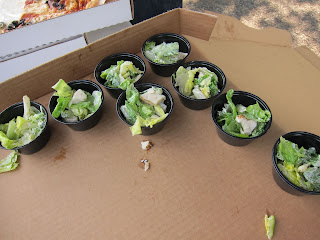 The big surprise for me along the race route came, when I saw there were little bowls of lettuce for the participants to sample. As those who know me can attest, I have a "thing" for lettuce because it is low-calorie, and helps "fill me up".
 In addition, there were samples of freshly-baked pizza along the walk route!! What a deal!!
 This photo shows some walkers as they are on the bridge above Interstate 5. The jagged peak in the background is a landmark along I-5, and is called Black Butte. I am thankful to be able to say my son and I summited that mountain last year, and you can read about that experience in a previous blog I published (It can be seen in the blog archives, under the date of September 10, 2016, and titled "Siskiyou County Expedition")
 In addition to the food/beverage sampling stations that appear every other block along the walking route, there are musical stages set up every other block along the race route. This photo shows a musician using a seldom-seen stringed instrument, accompanied by the traditional violin.
  There are also country/western bands, solo artists, brass musicians, vocalists, and drummers, both Native American and Oriental.
  All of the things I have described in the previous comments explain why it took me so long to finally make it to the FINISH line! I wanted to sample each and every product, and take a photo of each and every exhibit!
 My steps were easily distracted by the activities and foods along the way, which explains why I did not come home with one of these medals!
 When there were so many food and beverage products being handed to participants, there was a potential for litter to desecrate the streets of Mt. Shasta, but this issue was resolved by having refuse containers placed strategically after each sampling table.
 I was especially pleased that the refuse containers were clearly labeled so that plastics could be disposed of separately, and hence more easily recycled.
 The race route goes by the Catholic Church in Mt. Shasta, and every year, that community of believers sponsor a fund-raising pancake breakfast that provides a good excuse to load up on carbs before the race----it's for a good cause!!
 Just like the sign in this photo says,
  And for those who have an emergency that interferes with their smile, there is the Mt. Shasta Ambulance service!
 After the race was over, we went back to my son's house, and he grilled us a delicious, healthy dinner outside. He is shown in this photo, and I am using this opportunity to apologize to him for getting distracted taking photos during this event, that we had intended to walk TOGETHER! After it was over, he told me had spent several minutes concerned, worrying, and wondering where I was (thinking that I had possibly brought on a Reactive Hypoglycemic fainting spell by cramming too much food into my mouth, too fast), because he waited so long at the finish line, with no sign of me. When I told him that I was taking photos and videos of the performers, I think it hurt his feelings that I was more interested in taking photos, than I was in walking with him. Therefore, I am using this experience as the visual aid for one of my First Place 4 Health ( www.FirstPlace4Health.com ) memory verses that says, "Encourage one another daily, as long as it is called "Today," so that none of you may be hardened by sin's deceitfulness." Hebrews 3:13. Instead of concentrating on the precious time I had to spend with my son--the "TODAY"--I was focused on getting photos to write a blog about the event. Perhaps my behavior demonstrates how sin's deceitfulness made me think it was more important to publish a particular blog post, than it was to spend time encouraging my son. Hopefully, I will get another chance, and promise to do things differently next time I get to spend time with him! That is because doing activities with my son gives me "MILES OF SMILES"!! Tricia


 Some kids may grown up singing "Twinkle, twinkle, little star", but ever since I can remember, my refrain has been more like "Twinkle, twinkle, little shell!" I have had a lifelong interest in shells, so when I read that my favorite group travel supplier---Road Scholar (
  Although I have not traveled much in Florida, I have perused enough travel magazines to know that Sanibel Island is one of the few geographic locations that has a "body position" named after it! It is called the "Sanibel Stoop", and is illustrated in this photo. The name derives from the often-seen posture of people along the beaches of Sanibel Island. They are "stooping" over to pick up/examine some of the myriad of seashells that are to be found on the beaches of Sanibel Island.
 I
I  Each morning of the program, my pre-daylight beach stroll would have me ending up in the lovely restaurant of our resort, where I could enjoy the sun rising over the Gulf of Mexico horizon. The lodging for this Road Scholar program was the beachside property called Sundial Resort (
  According to the trained conchologist who gave a presentation on "How to shell" on Sanibel Island, this resort's location was where the most seashells were being found, during this time of year. As seen in this photo, some collectors use a specially-designed "scoop net" to bring up sealife for closer examination.
 I observed that not all of the beach visitors were interested in mollusks. Some folks were also trying their luck at surf fishing. The sun shining on the beach highlights the reason very few people go barefoot on this particular beach. It is absolutely COVERED in seashells! Those shiny spots in the photo are not pebbles!
  I mentioned earlier that I was able to see the sunrise over the Gulf of Mexico every morning, and likewise, I was able to enjoy the sunset over the water every evening. This is because Sanibel Island is a barrier island that lies almost perpendicular to the Florida mainland, instead of parallel to the mainland, as is usually the case for barrier islands. It is this perpendicular alignment that makes the shelling here so phenomenal. The beaches are exposed to more wave action/tide changes/currents that many other Gulf of Mexico barrier islands. Another thing that makes strolling the beaches of Sanibel Island so peaceful is the prohibition of high rise condominiums along the shoreline.
 The Sundial Resort had many guest amenities, including use of beach chairs, beach umbrellas, beach towels, tennis courts, bicycles, and KAYAKS! I was delighted to get the opportunity to do some ocean kayaking in the afternoons when our Road Scholar activities were complete for the day.
  After kayaking, there was usually time to do some sunset photography along the picturesque beach. Sanibel is usually ranked in the "Top Ten" Florida beaches list, and I definitely understand why!
 Our Road Scholar participants posed for a group photo on the lobby staircase at the Sundial Resort. It was fascinating to get to spend time with such great folks from all over the USA! Although we were strangers when we arrived on Sunday, we had made many new friends by the time the program ended on Friday!
 All of our breakfast meals were at the Sundial Resort, but for most of the meals beyond that, we tried a variety of delightful restaurants located around the island. I had wonderful meals at each and every one of them! Plus, since there was a refrigerator in my resort condo, I could ask for a leftover box to take home some of the ample portion sizes we were offered! The young lady in this photo without sunglasses, was our leader for the week, Julie Cardenas. She did a FANTASTIC job, and I hope to be able to attend some of the other Road Scholar programs she leads, that include kayaking adventures!
 A highlight of the program for me was visiting the Bailey-Matthews National Shell Museum (
  I can assure you this is the biggest "gastropod" I have ever had the privilege to hold in my hands!
  Our Road Scholar group was treated to a special program at the museum where we viewed a video about shells, and then were allowed to touch examples of specimens we had seen on the video.
 I have given a lot of thought as to why this kid who was born, and grew up in, "land locked" Arkansas, was so intrigued by shells. I have traced it back to this very helmet shell (shown in the photograph), that belonged to my grandparents, who lived in Locust, Arkansas. One of their sons lived on the California coast, and probably brought back the helmet shell to his parents on one of his return visits to Arkansas. This photo shows my grandparents, with me in the center, and I am pretty sure that I am holding that beloved helmet shell. When I was a child, that shell was like nothing I had ever seen before, and when they told me to hold it up to my ear to hear the sound of the ocean, it seemed to have magical properties! I am thankful that helmet shell survived their move from Locust, into the big city of Harrison, and that I am still "keeping it in the family" today!
 The fascination with the helmet shell, was the reason my eighth grade science project was all about mollusks! ( FYI-- Gastropods are the "single shell" specimens, and pelecypods are the "double shell" specimens). You can see the delight in my face because of the First Place ribbon I won! That early success in the marine sciences ( along with the Lloyd Bridges' Sea Hunt television series ) is probably one of the reasons I started out my college career, majoring in Marine Biology! If you know me, you know that I did not become a marine biologist, and my goals/dreams have seen many revisions. Thinking back about all the trials/tribulations/triumphs that have happened in my life since this photo was taken when I was 12 years old, I am reminded of one of my First Place 4 Health (